
When I built my sapele outdoor dining table four years ago, I finished it with oil-based polyurethane. The table spent summers outside, usually under a cover, and came indoors for most winters. For a while the finish looked great and did a good job of keeping the wood’s deep reddish color, but eventually irregular pale areas started appearing across the top. Some sections still had intact polyurethane while others had become rough and almost raw. Once moisture found its way through the weak spots, the film finish became part of the problem because the surrounding polyurethane slowed the wood from drying evenly. Repairing it properly meant cutting the tabletop back into individual boards, planing off the finish, jointing the edges and essentially rebuilding the top.
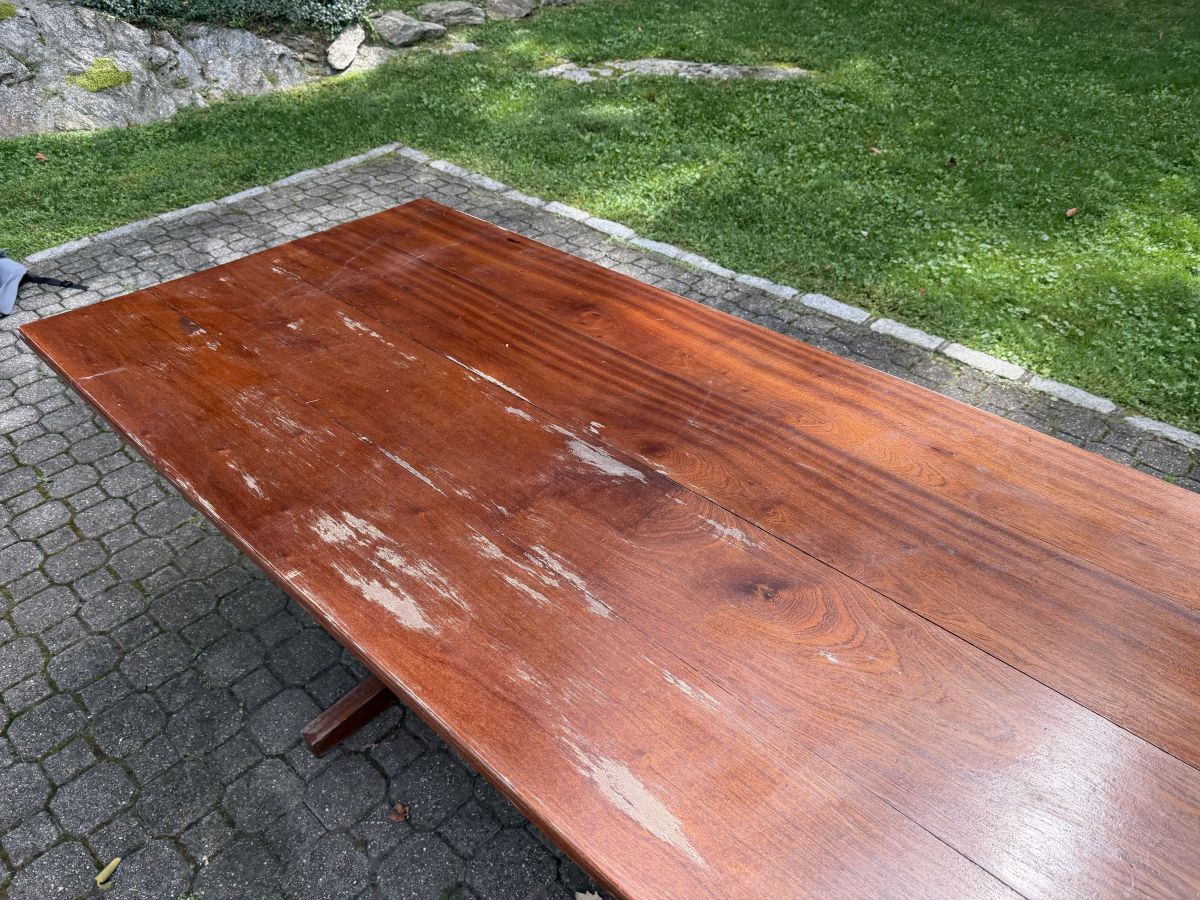
That experience changed what I wanted from the next finish. Polyurethane gives wood excellent protection while the film remains intact, but an outdoor tabletop is a difficult place to keep that film intact indefinitely. Sapele itself is a good exterior wood, so this time I wanted a finish that would work with the wood rather than sit on top of it. More important, I wanted a finish whose eventual failure mode was boring. If the finish starts looking tired in a few years, I want to clean the table and refresh it rather than discover isolated patches of bare wood underneath.
I looked seriously at Rubio Monocoat Hybrid Wood Protector because I like oil finishes and have used Odie’s Oil on an indoor dining table with excellent results. Rubio Hybrid is made for exterior use and solves some of the problems a simple furniture oil does not, particularly UV exposure, but most of its exterior protection comes with pigmentation. There is nothing wrong with that approach, and on a deck or outdoor structure it makes a lot of sense, but I did not really want to choose a gray, teak, black or otherwise deliberately colored version of sapele. Osmo UV Protection Oil 410 initially looked appealing because it is clear, but Osmo intends that product primarily for vertical exterior surfaces rather than horizontal tables where water can sit. Pure tung oil was another possibility, although it brings little UV protection and would require more attention outdoors. BLO and shellac made less sense for a table that will spend months in sun and rain.
I eventually settled on Penofin Hardwood Formula in Natural. It is a penetrating exterior finish, which puts it much closer to the problem I actually have. Rather than building a substantial coating over the surface, the oil should penetrate the wood and leave transparent pigment behind to help with UV exposure. “Natural” in Penofin’s terminology does not mean completely clear, but it also is not an opaque stain. On sapele I expect it to deepen and warm the wood much as an oil finish normally does while leaving the grain and natural variation visible.
The maintenance requirement is the compromise I am comfortable making. A penetrating exterior finish will need to be renewed periodically, particularly on a horizontal surface, but that maintenance should involve cleaning and recoating rather than another major refinishing project.